















SINGAPORE'S PREMIER
PRIVATE VOCAL COACH

In-Person. Customized. Transformative.
Master Mandopop and English Pop techniques with a Diploma-certified professional.

Chanel Sings

Chanel

Vocal Coach | Performer

FROM THE STAGE TO THE STUDIO

Meet Your Coach

Looking for private singing lessons in Singapore that actually deliver results? My journey began at age six, driven by a passion to master the art of performance.

With a Diploma in Music (Performance) and a Grade 8 Distinction from London College of Music, I combine rigorous vocal technique with real-world stagecraft.

Whether you are an aspiring professional or an adult looking to fix pitch accuracy (tone deafness), I tailor every lesson to your voice. We cover Mandopop, Cantopop, and English Pop styles.

Real Experience

Judge for "Pub Voice" & Resident Performer.

Versatile Styles

Mandopop, Hokkien, Cantopop & English Pop.

CERTIFIED & RECOGNIZED

Formal Training & Industry Experience

Songwriter's Music College

Diploma in Music Performance

Formal training in vocal technique and stage performance pedagogy.

London College of Music

Grade 8 Distinction

Achieved the highest graded examination level with distinction.

Xin Yao Pub Samurai

Competitor & Judge

Top 16 in Xin Yao (Age 16) and Season 4 Judge for "Pub Voice" (Pub Samurai).

PROFESSIONAL EXPERIENCE

Trusted Brands & Venues

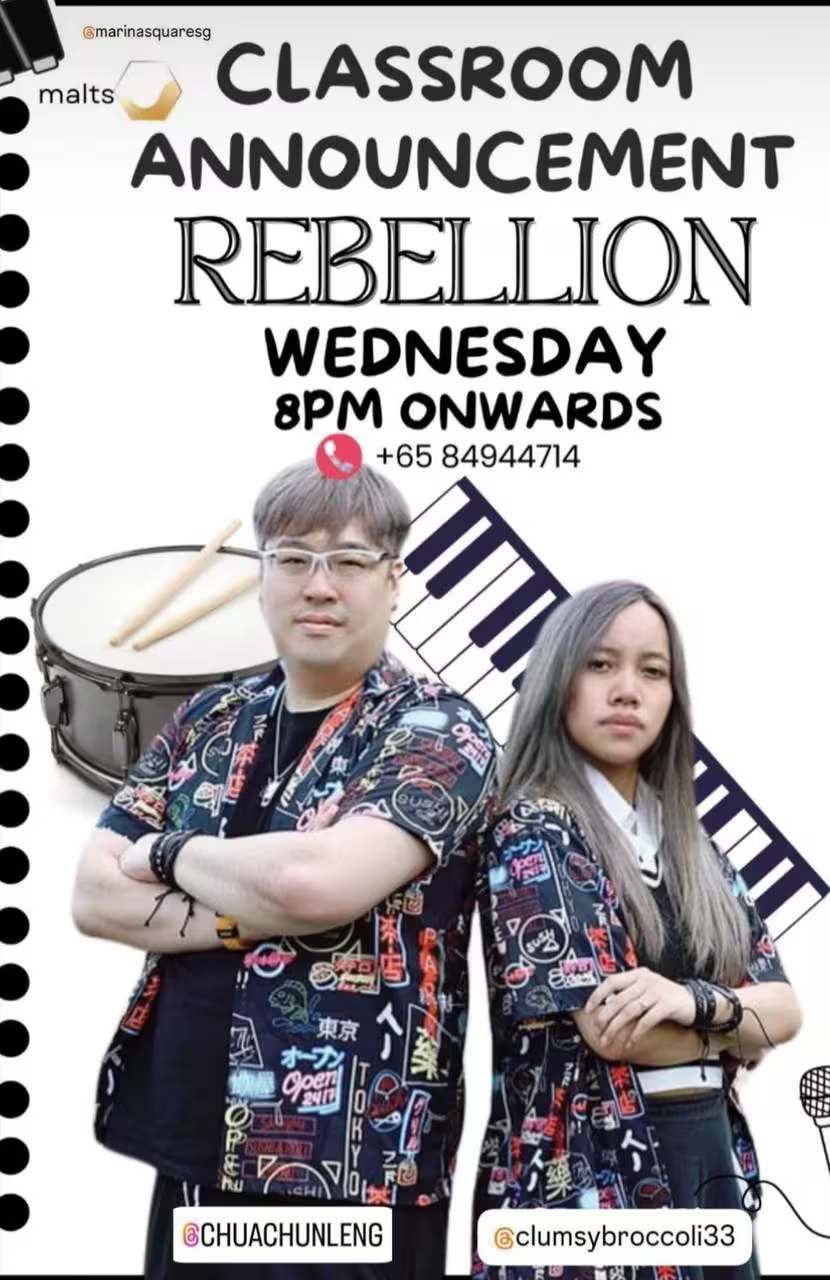
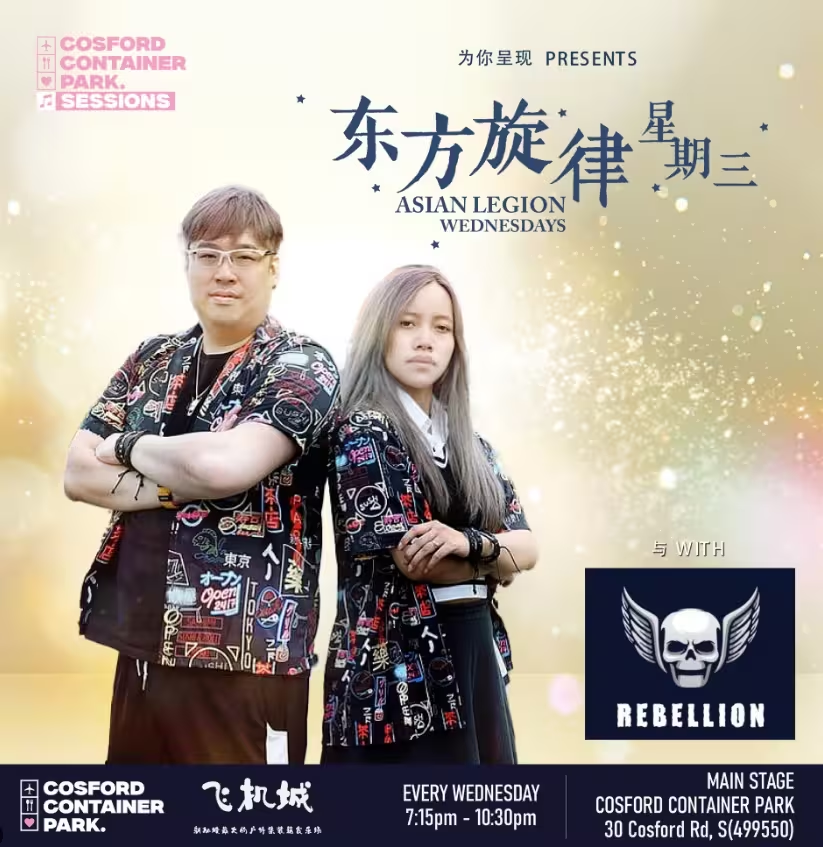
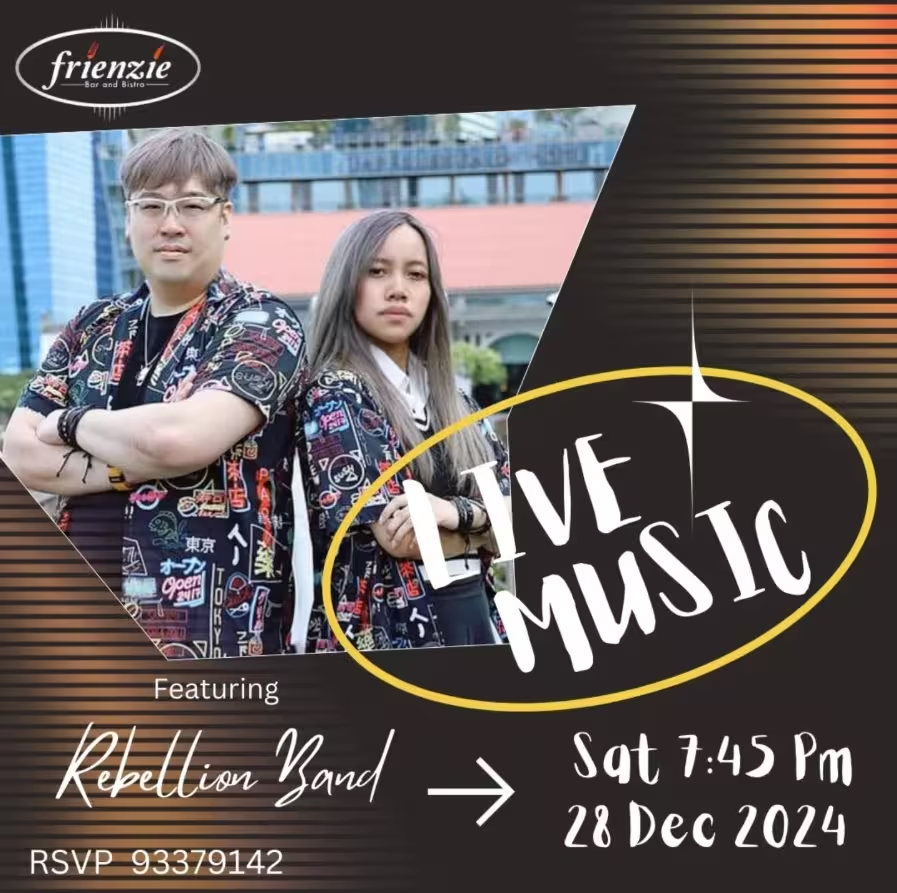
REBELLION

Resident Band • Mandopop • Pop Rock

@rebellionmusicsg

Collaborating with Singapore's premier lifestyle and entertainment venues.

Starhub
STARHUB
Tipsy Collective
TIPSY COLLECTIVE
Malts
MALTS
Cosford
COSFORD
The Mermaid
THE MERMAID

THE STORY

MORE THAN JUST A VOICE

"I don't just teach you how to sing. I teach you how to be heard."

Chanel Sings
Genres
Mandopop Cantopop Hokkien English Pop
Technical Focus
Pitch Accuracy Range Expansion Mixed Voice Belting Safety

A Passion Ignited Early

Chanel is a seasoned performer and vocalist whose passion for music was ignited at the tender age of six. While other kids were watching cartoons, she was dreaming of sharing her voice with the world, eagerly jumping at every opportunity to hold a microphone.

Her journey isn't just about talent; it's about resilience. From navigating the competitive circuit as a teenager to refining her craft academically, Chanel bridges the gap between textbook theory and the raw reality of live performance.

She doesn't just teach you to sing; she teaches you to perform.

Xin Yao
Top 16 Finalist

Xin Yao Competition

Kickstarted her journey at age 16 by competing against the nation's best young talent.

LCM
Grade 8 Distinction

London College of Music

Mastered the technical rigors of vocal performance, achieving the highest certification.

Diploma
Diploma in Music

The Songwriter Music College

Specialized in Performance. Formalizing her craft with deep theoretical and practical training.

Judge
Competition Judge

Pub Voice Season 4

Invited by Pub Samurai to judge aspiring singers, transitioning from competitor to industry authority.

MY TEACHING STYLE

"I am your most
BRUTALLY HONEST teacher."

Have you always been trying to find that one person who can tell you how good—or bad—your singing truly is? I don't sugarcoat. I listen, I analyze, and I tell you exactly what you need to hear to grow.

1

Analyze

I listen deeply to your voice to identify the specific habits holding you back.

2

Explain

No vague feedback. I explain exactly what you did right and what you did wrong.

3

Guide

We set realistic goals. I don't just point out errors; I give you the roadmap to fix them.

Who I Mentor

Aspiring Performers

Students looking to sing as a career, whether part-time or full-time. You want to own the stage.

Hobbyists

You share the passion but aren't aiming for pro status. You want to learn leisurely and enjoy the music.

Grading & Exams

Students looking to take exams or considering voice as a DSA instrument. We focus on technique and syllabus.

Fence-Sitters

Unsure if you're "good enough" for a career or just a hobby? I'll give you the honest assessment you need to decide.

LIVE ON STAGE

Past Gigs & Highlights

Rebellion at Malts
Rebellion at Cosford
Rebellion at Frienzie
Duo at Cosford
Duo at NTUC
Duo at HJ Bistro
Chanel at Ameising
Chanel at Bar Soccer
Duo at Paradise Now
Duo at Friends Kitchen

Vocal Coaching Rates & Packages in Singapore

Simple, transparent pricing.

No hidden fees. Just professional coaching.

Best Value

Regular Package

Consistent growth & mastery
$300
4 Lesson Bundle
  • 4 x 45 Minutes Sessions
  • Personalized Curriculum
  • Performance Prep
Flexible

Ad-Hoc Lesson

Pay as you go
$85
Single Session
  • 1 x 45 Minutes Session
  • Specific Song Coaching
  • Audition Prep

No Hidden Costs

What you see is what you pay

Deposit Waived

Zero deposit required

Reg. Fee Waived

$50 Registration is FREE

Note: Lesson fees are to be collected before lesson commencement.

VOCAL INSIGHTS

Expert Articles

The Ultimate Guide to Singing Lessons

Private vs Group. How to stop wasting money.

Read →

Mandopop vs. English Pop

The technical differences in resonance and vowels.

Read →

Am I Tone Deaf?

The truth about adult learning and pitch coordination.

Read →

Stage Performance Secrets

Stamina, mic technique, and overcoming stage fright.

Read →

The Ultimate Guide to Singing Lessons in Singapore: How to Stop Wasting Money and Start Finding Your Voice

By Chanel Sings | 12 Min Read


If you have typed "singing lessons Singapore" or "vocal coach sg" into Google recently, you have likely felt a wave of decision paralysis.

The search results are a chaotic mix of options. You see classical music academies offering graded exams, pop music schools promising to make you a K-Pop star in 3 months, community center group classes, and expensive masterclasses. The prices range from $30 an hour to over $150 an hour.

It is overwhelming. And for the adult professional looking to improve their voice—whether for the shower, the corporate stage, or the wedding reception—it is often unclear where to start.

Here is the hard truth that most commercial music schools won't tell you: Learning to sing is not like learning the piano. You cannot simply buy an instrument, place it in your living room, and start pressing keys. You are the instrument. Your instrument is biological, psychological, and deeply personal.

Part 1: The Landscape – Private Coach vs. Music School

When looking for vocal lessons, you generally have two distinct paths. Understanding the difference is the first step to protecting your investment.

1. The Commercial Music School (The "Gym Membership" Model)

Singapore is full of branded music schools. They are fantastic for socialization and for children who need a structured, social hobby. However, most rely on a standardized syllabus. They teach a "method" rather than teaching you. If you are an adult male with a heavy chest voice, you will likely get the exact same warm-up exercises as a teenage girl with a breathy tone.

The Reality: In a group class of 5 people, you get approximately 8 minutes of actual 1-on-1 attention per hour. The rest of the time, you are passively listening.

2. The Private Vocal Specialist (The "Chanel Sings" Approach)

This is bespoke engineering for your voice. This is for students who want results.

The Bespoke Advantage: A private specialist does not have a "syllabus." We have a diagnostic process. In your first session, I am not just listening to your pitch. I am watching your jaw tension. I am analyzing your tongue placement. I am looking at your posture.

Speed of Progress: My data shows that one hour of focused, private vocal engineering is equivalent to about 8-10 weeks of group classes. When the feedback is immediate and specific to your anatomy, the brain learns faster.

Part 2: The "Singaporean Voice" – Why Local Context Matters

You might wonder why you can't just take an online course from a famous American vocal coach. Why do you need a vocal coach in Singapore?

The answer lies in our linguistics. Singlish is efficient, fast, and staccato. We tend to speak from the back of our throat and cut our vowels short. When a Singaporean says "Book," it often comes out as a short, sharp "Buk" with a glottal stop. This speaking habit tightens the jaw and constricts the throat.

If you try to sing a soaring ballad with "Singlish placement," you will strain. You will hit a ceiling where you simply cannot go higher without cracking. A localized expert understands this mechanism. We know exactly which muscles you are overusing because we hear it in your speaking voice every day.

Part 3: The Technical Deep Dive

When you sign up for singing lessons in Singapore at a premium level, you should expect to learn more than just "breathe from your diaphragm." Here is the technical framework we use:

  • Breath Management (Appoggio): We do not just "take a deep breath." We use the Italian concept of Appoggio (to lean). It is about managing the air pressure. If you blow all your air out in the first three words, you have nothing left for the high note.
  • The Mix Voice (The Holy Grail): The Mix Voice is the art of blending Chest Voice and Head Voice. It is how Bruno Mars belts a high C without sounding like he is screaming. It is how Hebe Tien sings with power in her upper register.
  • Vocal Health & Stamina: I am an active performer. I know what it is like to sing for 3 hours straight in a smoky room with bad acoustics. I teach my students Vocal Hygiene: how to warm up, cool down, and handle phlegm and reflux (common issues in Singapore's food culture).

Part 4: The Economics – Cost vs. Value

Let’s address the elephant in the room. Premium vocal coaching in Singapore is an investment. You can find a student teacher on Carousell for $40/hour. You can find a master coach for $150+/hour.

Why the gap? When you pay for a premium coach, you are paying for Diagnostic Accuracy. A novice teacher hears a problem and guesses the solution. A master coach hears a problem and knows the cause. "You sound strained because your tongue root is depressed, pushing down on your larynx."

Time is your most valuable asset. Do not spend years practicing mistakes.

Mandopop vs. English Pop: The Secret Vocal Techniques You Need to Master Both

By Chanel Sings | 14 Min Read


Walk into any karaoke joint in Singapore—whether it’s a Teo Heng, K.Star, or a high-end private suite—and you will hear two very different musical worlds colliding.

In Room A, someone is belting out a power ballad by Adele or Bruno Mars. The sound is open, boomy, and resonant. In Room B, someone is pouring their heart out to a track by Eason Chan, GEM, or Eric Chou. The sound is tighter, brighter, and dripping with emotional restraint.

The truth is, Mandopop and English Pop are not just different languages. They are different instruments. They require different muscle configurations, different resonance strategies, and a different mindset. In this guide, we are going to break down the "Insider Secrets" of these two genres.

Part 1: The Linguistic Barrier – It’s All About the Vowels

The biggest reason you struggle to switch between genres is not your voice; it is the language itself.

English Pop: The Land of the "Open Throat"

English is a stress-timed language. In singing, specifically in Western Pop and R&B, we tend to modify vowels to make them "easier" to sing high. We often "open" the vowels. An "EE" sound (as in "See") is often modified to sound more like "Ih" or "Eh" as we go higher. Western technique encourages a dropped, relaxed jaw (the "Dopey" face). The goal is Resonance and Power.

Mandopop: The Challenge of Tonal Precision

Mandarin is a tonal language. If you change the shape of the word too much, you change the meaning. You cannot just "modify" the vowel whenever you feel like it. Mandopop singers often maintain "Closed Vowels" (like "Yi" and "U") much higher in their range than Western singers. This increases back-pressure in the throat.

The Fix: When I teach Mandopop, I focus on "narrowing the funnel." We don't try to make the sound huge; we try to make it laser-focused. We use a "smile" posture (retracting the lips slightly) to brighten the tone and help the vocal cords zip up for those high, closed vowels.

Part 2: Resonance – "The Mask" vs. "The Chest"

If you touch your chest while speaking, you feel a vibration. If you hum and touch your nose, you feel a vibration. These are your resonance chambers.

  • English Pop "Mix": Modern English Pop (think Ed Sheeran, Ariana Grande) relies heavily on a balanced Mix Voice. It is a blend of chest resonance and head resonance. It sounds like speaking, but louder.
  • Mandopop "Mask": Mandopop—especially the sad ballads (Ku Qing Ge)—relies heavily on Forward Mask Resonance. This is that buzzy, bright feeling right behind your nose and teeth. Because Mandarin words are often shorter and more staccato, we need them to cut through the music. Mask resonance adds "high frequency" shine to the voice.

The Exercise: To find your Mandopop voice, we use the "Ngang" sound. Say the word "Hung." Hold the "Ng" sound at the end. Feel the buzz in your nose? That is the placement you need for Chinese ballads.

Part 3: The Secret Weapon – "The Cry"

If there is one technique that defines Asian Ballads, it is "The Cry." Have you ever noticed that when you listen to a great Mandopop singer, it sounds like they are on the verge of tears? It’s not just acting; it’s a physiological technique.

When you cry (or pretend to cry), your larynx (voice box) tilts slightly, and your vocal cords thin out. This creates a sound that is lighter, more flexible, and emotionally piercing. It removes the "weight" from the voice. In Mandopop, we use this "Cry" to navigate the bridge between low and high notes. Instead of pushing harder to hit the high note (which sounds aggressive), we "cry" into the high note.

Part 4: Why You Need a Bilingual Coach

If you go to a traditional classical teacher, they will try to "fix" your Mandopop voice by making it sound operatic. You will end up sounding like a choir boy singing Jay Chou. It kills the vibe. If you go to a purely "Speech Level Singing" coach who only knows American Pop, they might not understand the tonal nuances of Mandarin.

At Chanel Sings, we are bilingual in technique. I understand that when you sing "Shuo Hao De Xing Fu Ne," you need a different vocal configuration than when you sing "All of Me." We practice the "Forward Shift" for Mandarin and the "Vertical Drop" for English. We work on your diction so you don't sound like a "Potato Eater" (unclear Chinese pronunciation) or a "Singlish Speaker" (choppy English phrasing).

Am I Tone Deaf? The Truth About Adult Singing Lessons in Singapore

By Chanel Sings | 10 Min Read


It’s a familiar scene in Singapore. You are at a corporate bonding session, a friend’s wedding, or a late-night session at Teo Heng. The microphone is being passed around. Everyone is laughing. But as the mic gets closer to you, your heart starts pounding. You start preparing your excuses: "No lah, I cannot sing."

If this sounds like you, I want you to know two things: You are not alone, and you are almost certainly NOT tone deaf.

Part 1: The "Tone Deaf" Myth vs. The Science

Let’s get the medical definition out of the way. Amusia (Tone Deafness) is a real neurological condition. It affects the brain’s ability to process musical intervals. A truly tone-deaf person cannot distinguish between the soundtrack of Star Wars and the sound of a vacuum cleaner.

Research shows that true Amusia affects only about 4% of the population. If you can recognize a familiar tune when it plays on the radio, or tell when an American Idol contestant is singing badly, your hardware is working fine. You are not tone deaf. You are uncoordinated.

Singing is a loop: Input (Ear) -> Processing (Brain) -> Output (Vocal Cords). For "bad singers," the connection between Processing and Output is rusty. You hear the note C, but your vocal cords give you a B-flat. That is not a hearing problem; it is a muscle memory problem.

Part 2: Why Adults Struggle (The "Paiseh" Factor)

In Singapore, we have a culture of excellence. We are taught from a young age that if we aren't good at something immediately, we should stop doing it. If you weren't selected for the choir at age 7, or if a teacher told you to "mouth the words," you internalized a label: "Non-Singer."

As adults, this label hardens. Children sing loud and wrong and don't care. Adults are terrified of judgment. This tension tightens your throat muscles, which—ironically—makes it harder to sing on pitch. It is a self-fulfilling prophecy.

Despite the fear, adults are actually better students than children. You have discipline, analytical thinking, and emotional depth. You have lived. When you sing a love song, you can access an emotional depth that a child simply cannot.

Part 3: The Fix – How We "Tune" Your Voice

When you search for singing classes in Singapore for beginners, you need a Vocal Mechanic. Here is the protocol I use for pitch-challenged adults:

  • Step 1: The Drone (Locking In): We don't start with songs. Songs are too fast. We start with a Drone. I play a single continuous sound, and you have to hum and slide your voice until you "lock in" with the sound. This teaches your brain what "in tune" feels like physically.
  • Step 2: The Siren (Connecting the Range): Most beginners only use their "Chest Voice" (speaking voice). We make ghost noises or siren sounds to slide from low to high. This tricks your brain. Because it’s a "silly sound," you relax. It smoothes out the "cracks."
  • Step 3: Range Extension: Many men think they can't sing because they are trying to sing songs written for tenors (like Bruno Mars) when they are baritones. We identify your Tessitura—the part of your range where your voice sounds rich and easy.

Part 4: Why Private Coaching is Non-Negotiable for Beginners

I will be honest: If you have pitch issues, do not join a group class. In a group class, you will hide. You will sing quietly so no one hears you. You will rely on the other voices to carry the tune. You will not improve.

You need a safe, private space where you can make weird noises, crack, fail, and try again without judgment. At Chanel Sings, my studio is a "Zero Judgment Zone." I have specialized tools and software that visualize your pitch in real-time on a screen. You can see if you are sharp or flat. This visual feedback bridges the gap until your ear catches up.

From Karaoke to Stage: A Singaporean Singer’s Guide to Conquering Stage Fright and Vocal Stamina

By Chanel Sings | 15 Min Read


There is a moment that every aspiring singer dreams of. The lights dim. The crowd at the bar—maybe it’s Tipsy Penguin or Timbre—goes quiet. You step up to the microphone. But here is the reality that hits you in that first 10 seconds: Singing on stage is nothing like singing in a studio.

The acoustics are different. The monitors might be too loud or too quiet. The lights are blinding. And halfway through the third song, your voice starts to feel scratchy. You still have 40 minutes left in the set. What do you do?

Part 1: The Stamina Game – It’s a Marathon, Not a Sprint

Most students practice one song at a time. But a standard live set in Singapore is 45 minutes. That is roughly 10 to 12 songs, back-to-back, with almost no breaks. Around the 20-minute mark, untrained singers hit a wall. You lose your low notes, and your high notes become tight.

The Solution: "The Mark." In my advanced coaching, I teach students how to "Mark." This is a technique used by pros to sing at 60-70% intensity while maintaining pitch and rhythm. We modify the vowels to be more narrow and use less air pressure during the "filler" verses of low-energy songs, saving your "full belt" for the climax of the show.

Part 2: Mic Technique – Your New Instrument

A microphone is not just a stick that makes you louder. It is an instrument. Most beginners hold the mic like an ice cream cone—too low, too far, or cupped.

The "Cupping" Sin: Wrapping your hand around the metal grille of the mic changes the polar pattern, causing Feedback and making your voice sound muddy. Fix: Hold the mic by the handle.

The Proximity Effect: Getting closer boosts bass frequencies (good for ballads). Getting further thins out the sound (good for high belts). In my studio, we rehearse with a microphone plugged into a PA system. I teach you the "Chin Anchor" for consistency and the "Pull Away" for dynamics.

Part 3: Conquering Stage Fright

"Stage Fright" is biologically identical to "Excitement." It is just Adrenaline. Your body goes into Fight or Flight. Your mouth goes dry, and your legs shake.

The Dry Mouth Nightmare: This is caused by adrenaline shutting down your salivary glands. Do not drink gallons of cold water; it shocks the vocal cords. Instead, bite the tip of your tongue (gently!) or eat a slice of green apple to stimulate saliva.

The Mental Reframing: I teach my students a psychological trick: Renaming the Feeling. When your heart races, do not say, "I am nervous." Say, "I am primed." Your body is giving you extra energy. Use it. That shaky energy can be channeled into emotional intensity.

Part 4: Monitors and Ears – Hearing Yourself

The biggest shock for new performers is that you cannot hear yourself on stage. The sound from the main speakers is pointing away from you. If you cannot hear yourself, you will instinctively push harder and yell. This is the #1 cause of vocal blowout.

In my lessons, we simulate "bad monitoring" environments. I teach you how to feel the vibration in your skull (bone conduction) to stay in tune even when you can't hear the speakers. This is a survival skill for any Singaporean busker or gig musician.

START YOUR JOURNEY

Book Your 30-Min Trial

Limited slots available at the promo price of $20.

We will process your request securely.